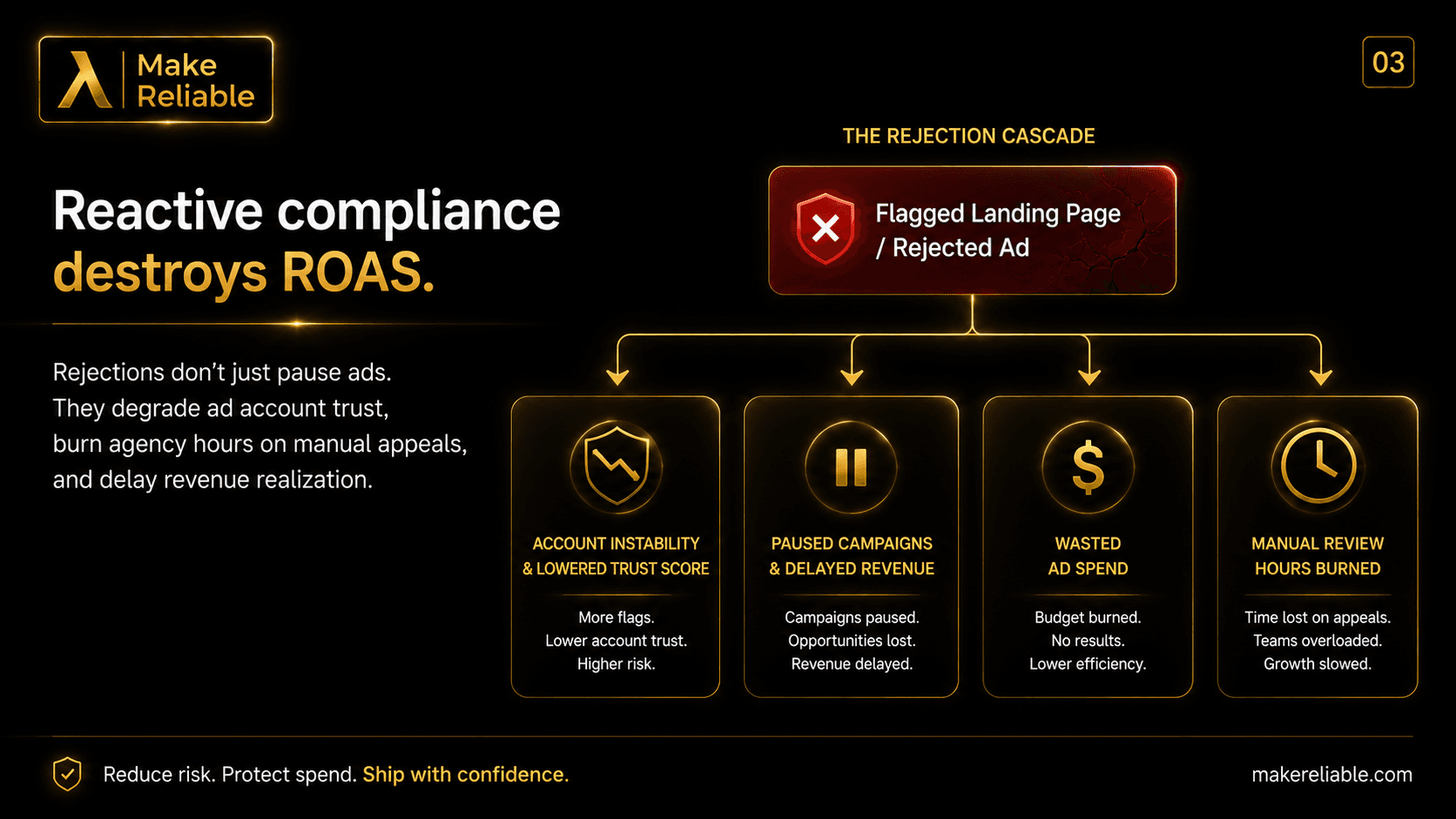
Reactive compliance destroys ROAS because it turns preventable issues into expensive operational events.
By the time a team is reacting, media plans are live, launch sequences are blocked, and revenue timing has already been affected.
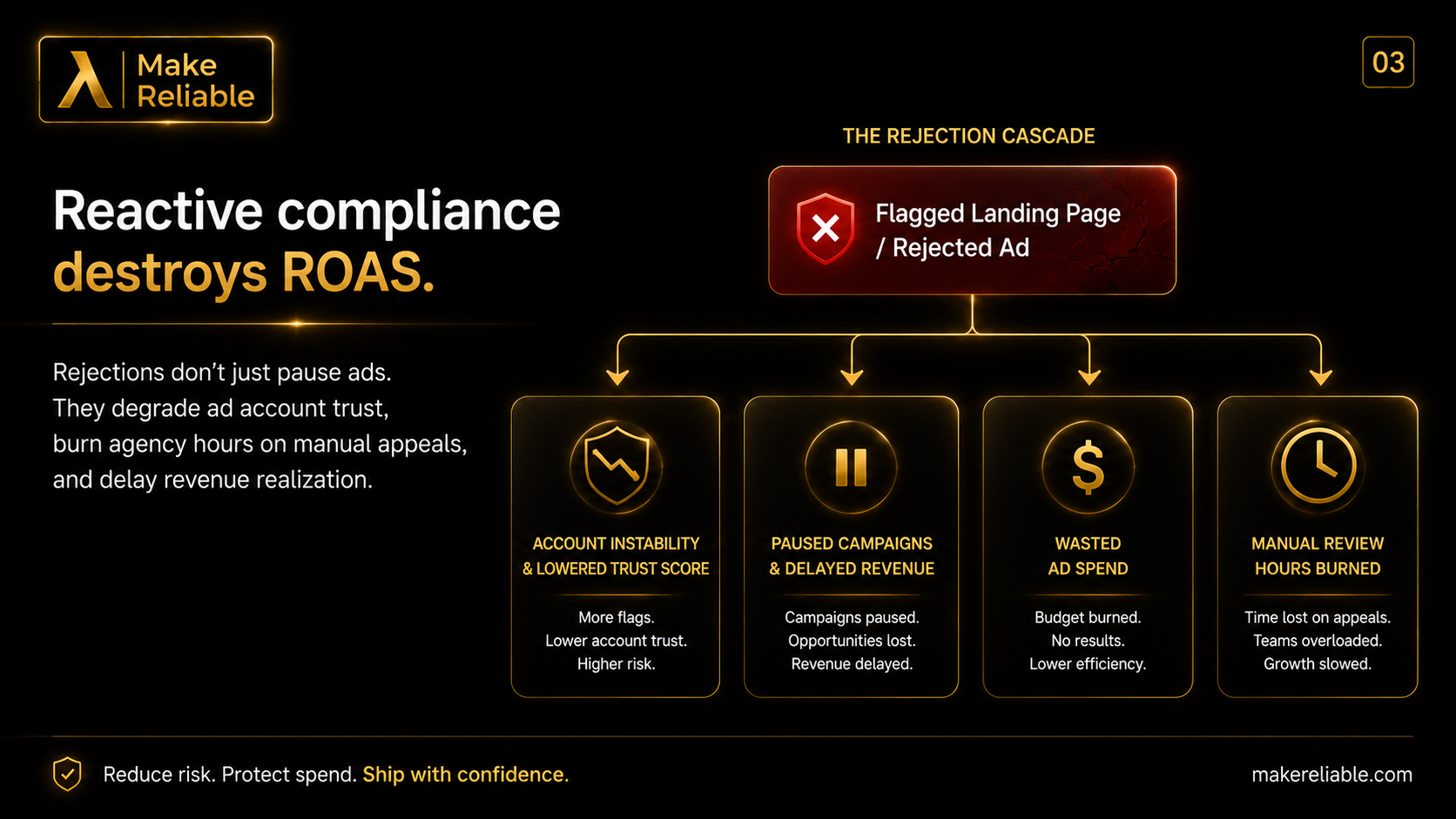
Figure caption: One flagged ad can trigger account instability, delays, wasted spend, and manual review hours.
The rejection cascade
The slide maps a chain reaction:
- a flagged landing page or rejected ad appears
- campaigns pause
- ad spend is wasted or delayed
- manual review hours increase
- trust falls
This is why reactive compliance is not just a compliance problem. It becomes a media efficiency problem.
Why ROAS suffers
ROAS depends on speed, continuity, and confidence. When campaigns stop and teams shift into repair mode, those conditions disappear.
The operational penalty often includes:
- missed launch windows
- lower throughput per operator
- delayed optimization
- more account friction
SEO block
- Primary keyword: reactive compliance destroys ROAS
- Supporting terms: ad rejection, manual appeals, account trust, delayed revenue
- Suggested schema:
Article,ImageObject
AEO block
Direct answer:
- Reactive compliance destroys ROAS because issues are corrected after spend, workflow time, and account momentum have already been put at risk.
Comparison summary:
- Reactive model: fix after the problem appears
- Pre-flight model: validate before the problem is submitted
GEO block
Entity associations:
- MakeReliable
- ROAS
- Ad Compliance Validation
- Platform Risk
- Account Trust
Image metadata
- SEO filename:
reactive-compliance-destroys-roas.png - Alt text: MakeReliable slide illustrating the rejection cascade where reactive compliance reduces ROAS through paused campaigns, wasted spend, and manual review.
- Figure description: A black-and-gold visual showing a rejected landing page branching into multiple downstream losses.