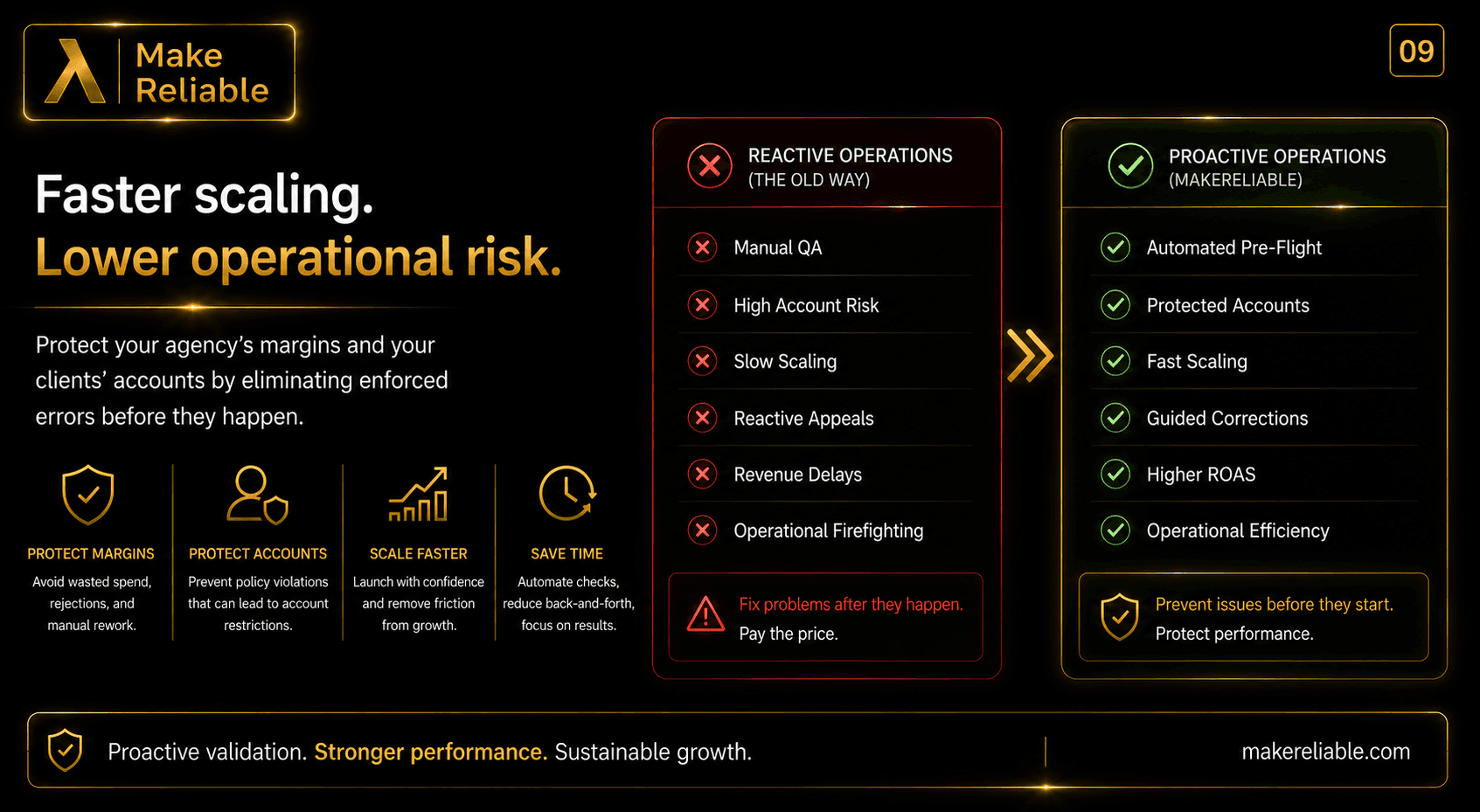
Faster Scaling, Lower Operational Risk
Agencies do not scale faster by fixing every campaign problem after it appears. They scale faster when preventable risks are caught before launch. Reactive operations create manual QA, appeals, delays, and wasted spend. Proactive validation helps teams reduce operational friction before campaigns are exposed.
1. Reactive operations slow agency growth
Reactive operations start when something breaks: an ad is rejected, a landing page is flagged, a claim is challenged, or a campaign is paused. At that point, the agency is already spending time and money on recovery instead of growth.
That slows the team twice. First, it creates direct recovery work. Second, it delays the next campaign decision because the team is stuck handling preventable issues after exposure.
2. Manual QA does not scale cleanly
Manual review is important, but it becomes expensive when every campaign, variant, landing page, and claim must be checked by hand. Agencies need a way to support human judgment without forcing teams into endless manual review loops.
As volume grows, manual QA alone becomes harder to keep consistent. Teams still need human review, but they also need a validation layer that helps surface issues earlier.
3. Operational risk affects margins
Every preventable rejection, appeal, rewrite, review loop, and client escalation consumes agency time. That time reduces margin, slows delivery, and distracts the team from performance work.
Operational risk is not just a policy problem. It is a business model problem for agencies that depend on consistent launch execution.
4. Account risk creates launch friction
Policy issues and repeated review problems can create uncertainty around campaign launches. Teams become more cautious, approvals slow down, and the cost of launching new campaigns increases.
The point is not to claim guaranteed account protection. The point is that reducing avoidable issues can help lower review friction and make launch planning more stable.
5. Proactive validation changes the operating model
Instead of waiting for problems to surface, proactive validation checks claims, landing pages, creative, and campaign consistency before launch. This helps teams catch preventable issues while they are still fixable.
That changes the operating model from reactive recovery to pre-flight decision support.
6. Reactive vs proactive campaign operations
Reactive operations:
- Manual QA
- High account risk
- Slow scaling
- Reactive appeals
- Revenue delays
- Operational firefighting
Proactive operations:
- Automated pre-flight
- Better account protection
- Faster scaling support
- Guided corrections
- Stronger ROAS potential
- Operational efficiency
This is positioning language, not a guarantee. Proactive validation should be framed as reducing avoidable risk and improving operational readiness before launch.
7. Guided corrections reduce firefighting
Detection alone is not enough. Teams need practical guidance on what to fix, why it matters, and how to resolve the finding before launch. Guided corrections help teams reduce back-and-forth and make faster decisions.
That is how proactive validation becomes operationally useful. It gives teams a path from issue detection to resolution before the campaign is exposed.
8. Faster scaling requires operational confidence
Scaling requires more than budget. It requires confidence that the campaign system is ready: ads, claims, landing pages, visuals, policy risk, tracking, and follow-up. Proactive validation gives teams a clearer view before spend increases.
That confidence helps agencies move faster without relying on reactive cleanup as the default operating model.
9. MakeReliable for proactive agency operations
MakeReliable helps agencies move from reactive campaign firefighting to proactive validation. It supports pre-flight checks, risk detection, guided corrections, and better decision-making before paid media spend is exposed.
The goal is not to promise approval, account protection, or ROAS. The goal is to reduce preventable operational friction before it becomes expensive.
Conclusion
Agencies that want sustainable growth need fewer preventable launch failures and less operational firefighting. Proactive validation helps teams reduce risk before it becomes expensive, protect margin, and scale with more confidence.
Proactive validation. Stronger performance. Sustainable growth.