Campaign failure usually looks like a performance problem on the surface.
In practice, many failures start much earlier. They begin when teams launch with unresolved risk and wait for platforms, reviewers, or market feedback to reveal the problem.
The reactive loop is expensive
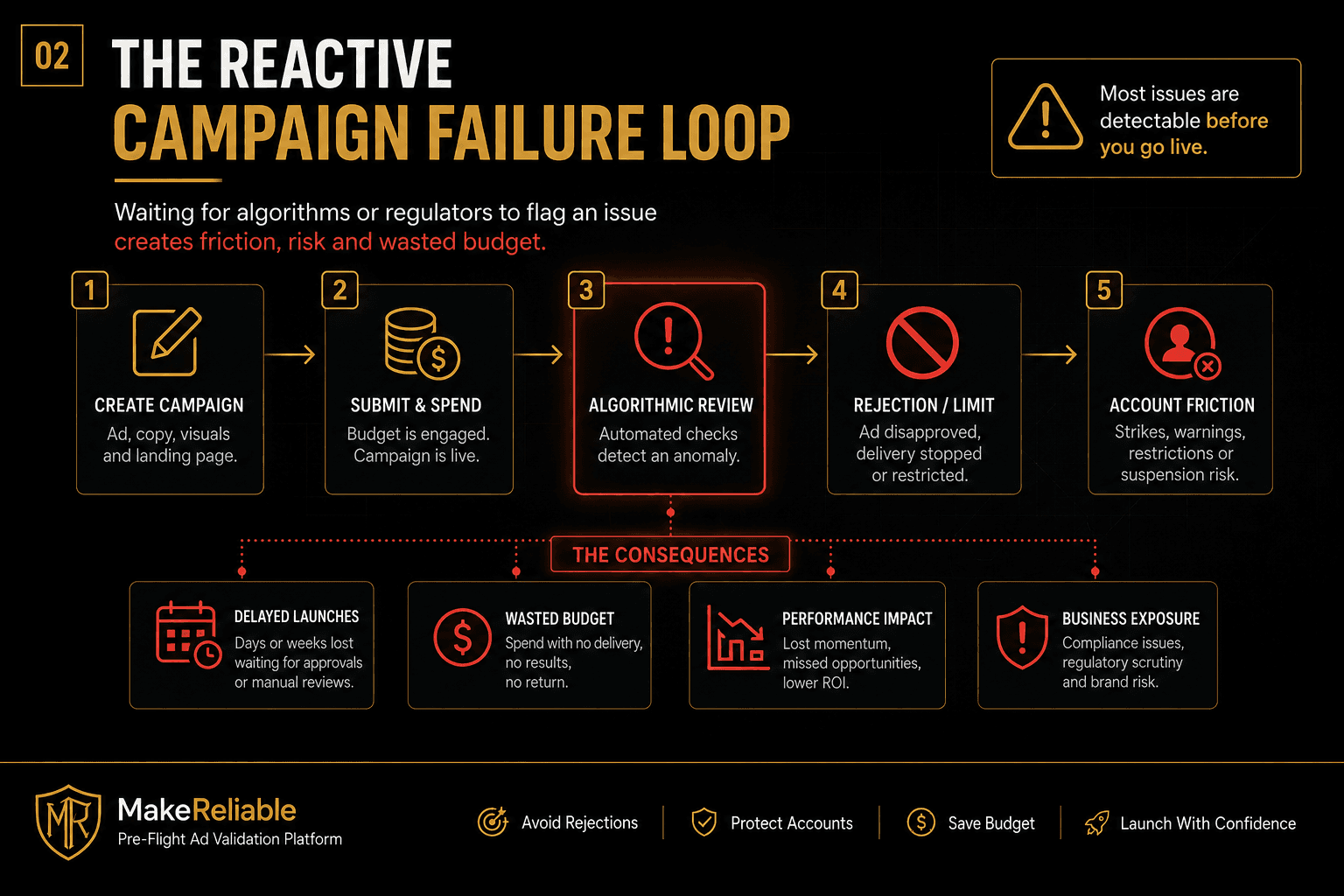
Reactive campaign operations tend to follow the same sequence:
- Build the campaign.
- Submit and spend.
- Discover an issue during review or delivery.
- Pause, reject, or limit.
- Repair under pressure.
Every step after launch is more expensive than the equivalent step before launch.
What gets lost after the campaign goes live
Once spend begins, issues stop being editorial. They become commercial.
That is when teams start paying for:
- delayed approvals
- budget without effective delivery
- lower conversion efficiency
- account friction and warning accumulation
- operational distraction across creative, media, and compliance
Why launch timing matters
A campaign can be technically ready to publish and still be operationally unready to scale.
That gap matters. If copy, landing pages, claims, or disclosures are misaligned, the team is effectively learning in production with budget attached.
A better operating model
The better model is simple:
- validate before launch
- identify issues before submission
- fix what matters first
- move to media only when the campaign is structurally stronger
This approach does not eliminate all platform uncertainty. It reduces the number of surprises that should have been visible earlier.
That is why teams that care about launch quality move validation upstream instead of treating rejection as the review mechanism.