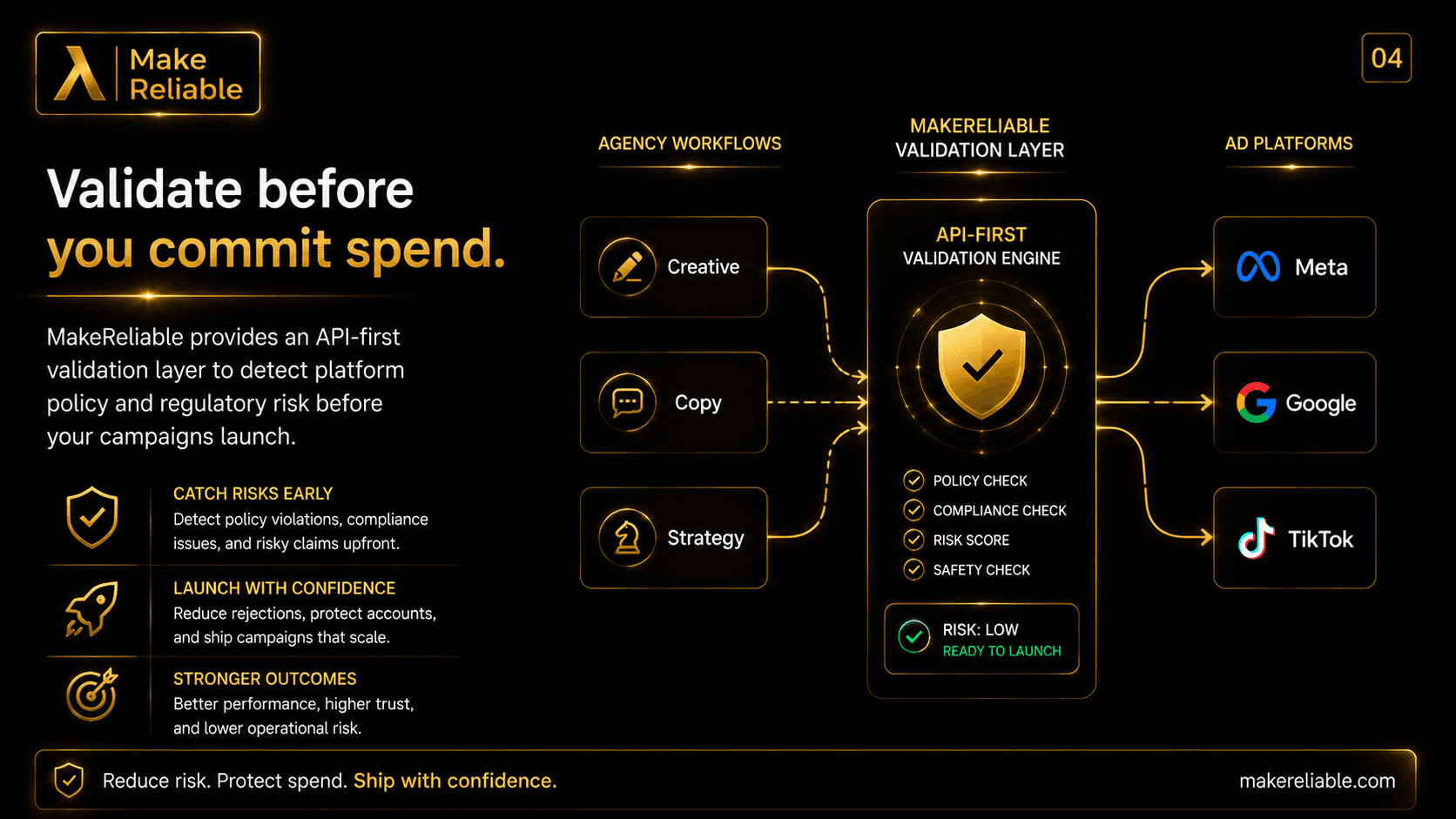
Paid media risk is often discovered after the budget is already committed. Creative is approved, copy is written, the strategy is locked, and the campaign is ready to launch. Then a rejected ad, flagged landing page, risky claim, or platform mismatch forces the team into reactive fixes. By that point, time, budget, and launch momentum are already exposed.
Internal approval is not the same as launch readiness
A campaign can look ready inside an agency or growth team while still carrying platform policy risk, regulatory risk, landing page mismatch, or operational follow-up issues. Internal approval should not be the final validation step before spend is committed.
Creative signoff, copy approval, and strategy alignment are necessary, but they do not tell the full story. A campaign is not truly launch-ready until the message, destination page, form path, and policy exposure have been checked together.
Campaign risk starts inside the workflow
Risk can enter through creative, copy, or strategy. A visual promise, a claim, a CTA, a pricing statement, a landing page section, or a platform choice can create risk before the campaign ever reaches Meta, Google, TikTok, or another ad platform.
This is why campaign risk should be treated as a workflow problem, not only a platform problem. The risky input often appears long before a reviewer or platform system sees it.
The expensive mistake is discovering risk after launch
Once spend is committed, every issue becomes more expensive. A rejection can delay the launch. A landing page mismatch can reduce conversion quality. A claim issue can force rewrites. A platform flag can slow the campaign and burn team hours.
The cost is not only the visible spend. Teams also lose launch timing, operating focus, and learning velocity. Late discovery turns small issues into expensive recovery work.
Paid media needs a validation layer before platforms see the campaign
Teams need a layer between agency workflows and ad platforms. This layer should check campaign assets before the platform review process becomes the first real risk detector.
Creative / Copy / Strategy → API-first validation engine → Meta / Google / TikTok
When that layer exists before launch, teams can surface issues while changes are still cheap and controlled.
What should be validated before spend is committed
Teams should validate:
- policy risk
- compliance signals
- claim consistency
- landing page alignment
- CTA and form flow
- tracking and follow-up readiness
- launch confidence and risk score
These checks do not replace team judgment. They make it easier to see where the campaign system is fragile before money is committed.
API-first validation makes the workflow scalable
Manual review alone does not scale well across many campaigns, variants, platforms, and landing pages. An API-first validation layer can help teams check assets more consistently before launch, while still leaving final judgment and approvals to the team.
As campaign volume grows, manual review becomes harder to keep consistent. API-first validation helps teams bring the same pre-launch discipline across more assets without waiting for problems to appear live.
Validation does not guarantee approval
MakeReliable does not guarantee platform approval, legal compliance, or campaign performance. The value is reducing avoidable risk, improving operational readiness, and helping teams catch issues before they commit spend.
That distinction matters. The goal is not to promise certainty. The goal is to make launch decisions more informed and more reliable.
Validate before you commit spend
MakeReliable helps teams review creative, copy, strategy, landing pages, policy risk signals, regulatory risk, and launch readiness before campaigns go live. The goal is to reduce avoidable rejections, protect budget, and ship campaigns with more confidence.
If you want to validate the campaign before launch, start here:
Validate your campaign before launch
Related landing pages:
Conclusion
Spend should be committed after the campaign system has been checked, not before. Teams that validate early can reduce avoidable friction, protect launch momentum, and make paid media operations more reliable.
Reduce risk. Protect spend. Ship with confidence.