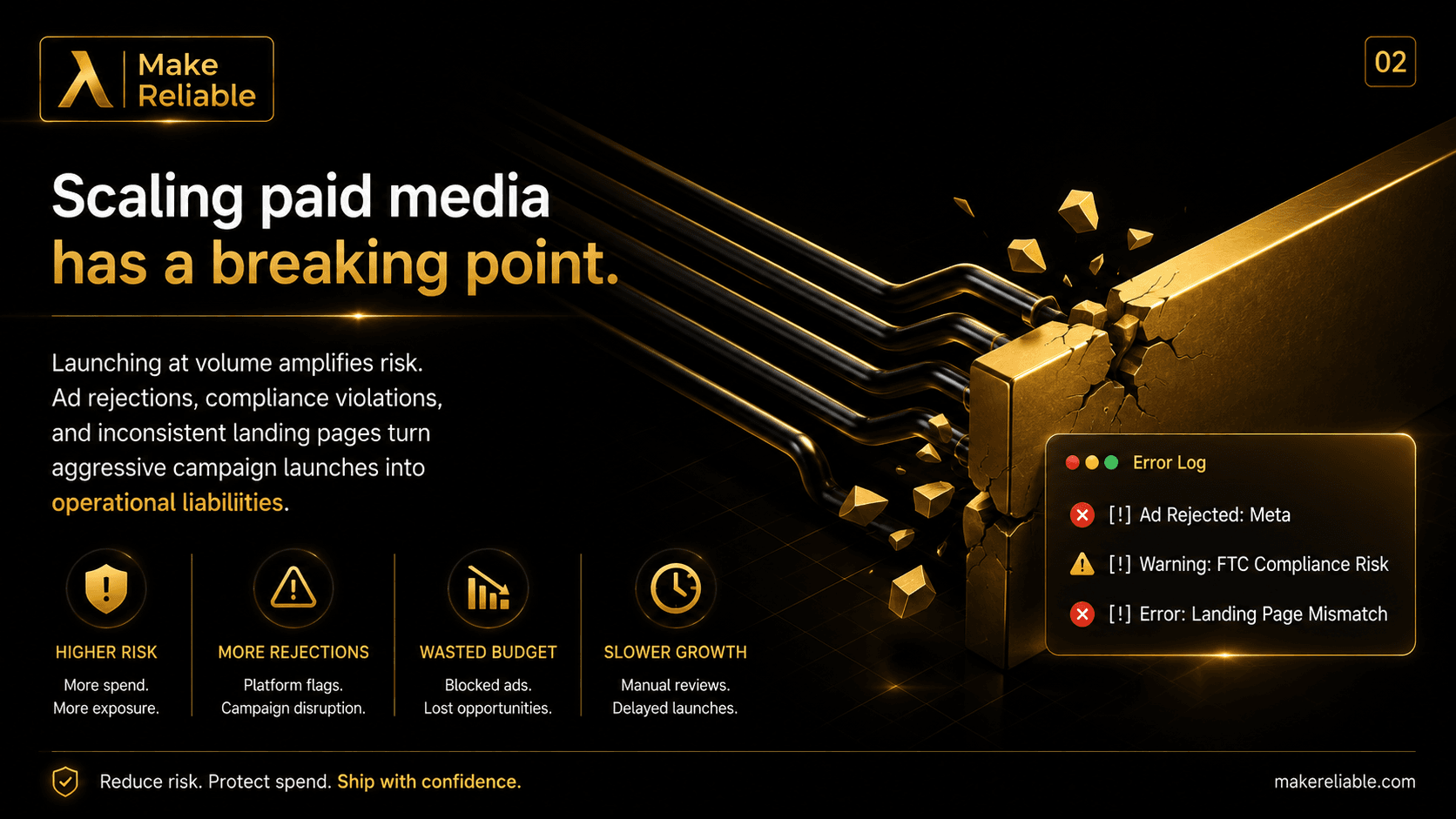
Paid media does not usually break because one ad is bad. It breaks because the campaign system becomes fragile at the exact moment spend increases. A weak claim, a policy mismatch, an inconsistent landing page, or a broken follow-up path can become expensive once the campaign moves from testing to scale.
Scaling increases exposure, not just reach
More budget means more impressions, more reviews, more edge cases, more scrutiny, and more chances for inconsistencies to surface. Scaling does not remove operational risk. It amplifies it.
A claim that survived a small test can attract new review behavior when spend rises. A landing page that worked for one audience can feel misaligned when additional ad sets, offers, or geographies go live. More reach creates more opportunities for friction to show up in public, in platform review, and inside the operating workflow behind the campaign.
The first failure is often an ad rejection
A rejected ad can delay launch, interrupt momentum, force manual review, or require last-minute creative changes. The real cost is not only the rejected ad. It is the disruption to the campaign plan.
Once the launch clock is running, teams lose time fast. Buyers wait on revisions, operators reroute approvals, and learning loops slow down before the campaign has a chance to produce useful signal. The rejection is visible. The operational drag behind it is the deeper problem.
Compliance risk compounds with volume
Claims that look harmless in isolation can become risky when repeated across variants, audiences, platforms, and landing pages. Paid media teams need a validation layer before launch, not only a post-rejection fix.
At scale, teams are not just managing one message. They are managing combinations of hooks, claims, page sections, disclosures, forms, and platform-specific constraints. If validation happens only after rejection, risk compounds faster than the team can respond.
Landing page mismatch creates hidden campaign risk
Ads and landing pages must tell the same story. If the ad promise, page headline, CTA, proof, pricing, or form flow do not align, the campaign becomes unreliable. Mismatch can affect approval, conversion, trust, and follow-up quality.
This is one of the most expensive failure modes in paid media because it often hides inside campaigns that appear ready. The creative can look strong. The media plan can be approved. But if the destination page cannot support what the ad implies, the whole launch becomes fragile.
Wasted budget is often an operational problem
Budget is wasted when campaigns are paused, rejected, misrouted, manually reviewed, or sent to pages that do not support the ad promise. The media spend is only one visible cost. Lost momentum and delayed learning are also costs.
When teams talk about wasted spend, they often focus on targeting or creative efficiency. Operational waste is just as real. Delayed launches, broken routing, inconsistent forms, and manual escalation all reduce the value of the budget long before optimization begins.
The campaign chain must be validated before scale
Ad claim → Platform policy → Landing page promise → Form → Tracking → Follow-up → Scale
A campaign should not be considered ready because the creative is finished. It is ready when the whole chain is consistent and operationally safe.
That means checking whether the claim is supportable, whether the landing page reinforces the same promise, whether the form and tracking behave correctly, and whether commercial follow-up can handle the lead path the campaign is about to generate. Launch readiness is a system question, not only a creative question.
Validate before you scale
MakeReliable helps teams reduce risk before budget is committed by checking campaign claims, landing page alignment, policy risk signals, launch readiness, and commercial follow-up routing.
The goal is not to promise approval or remove every source of uncertainty. The goal is to reduce avoidable rejection risk, protect paid media spend, and help teams scale with stronger operational control.
If you are preparing to increase campaign volume, use the paid media risk check before scaling spend:
Conclusion
More spend should not create more fragility. Before scaling paid media, teams need to validate the assets, the claims, the landing page, and the operational path behind the campaign.
Reduce risk. Protect spend. Ship with confidence.