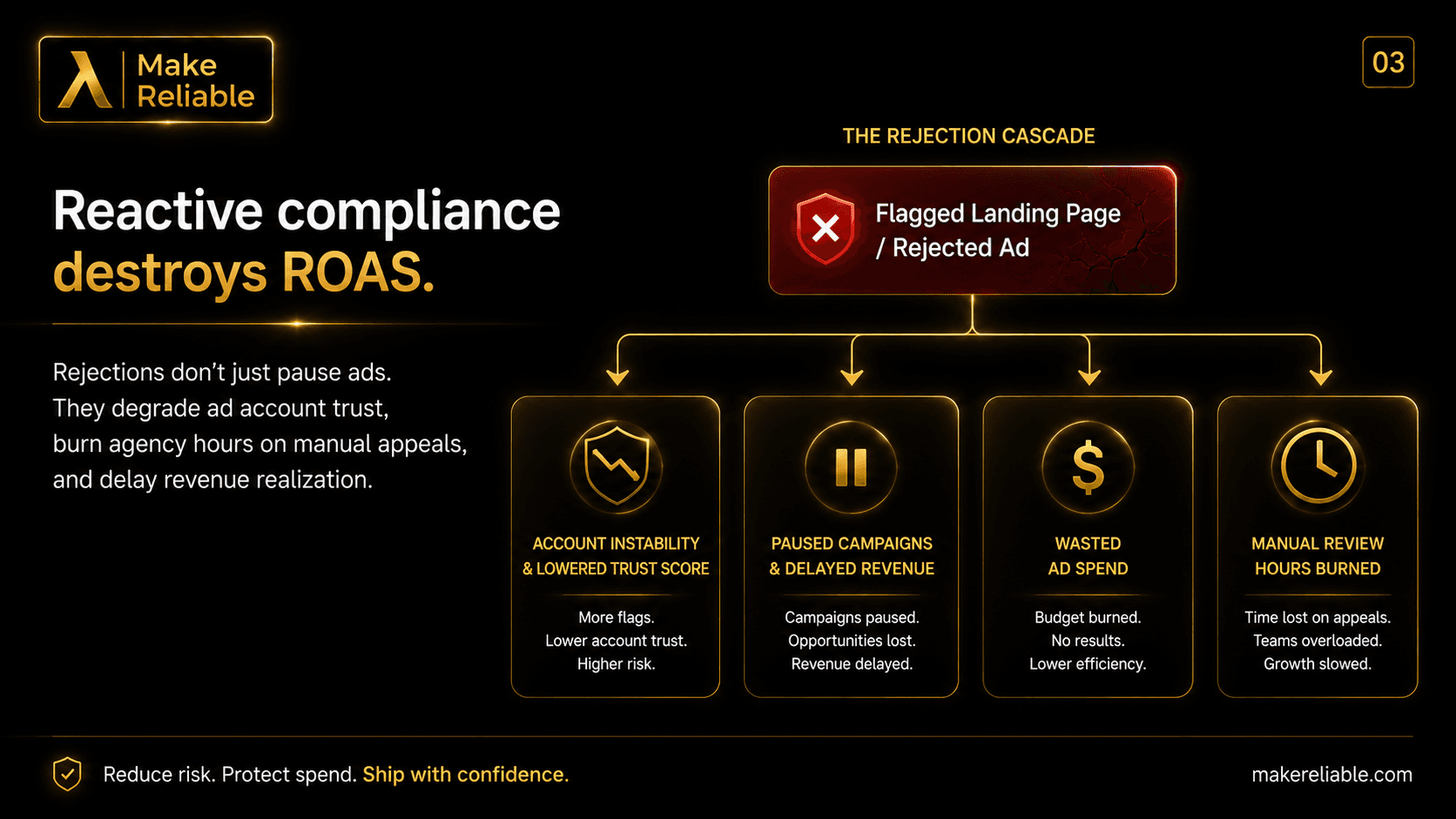
Reactive compliance feels efficient until the campaign is already live. A rejected ad, flagged landing page, or late policy issue does not only pause delivery. It can damage account stability, waste budget, burn team hours, delay revenue, and reduce the efficiency the campaign was supposed to create.
Reactive compliance starts too late
If compliance review happens only after an ad is rejected or a landing page is flagged, the campaign has already entered the expensive zone. Budget is exposed, launch timing is disrupted, and the team is forced into recovery mode instead of controlled execution.
By the time the issue becomes visible, the real damage is no longer limited to policy friction. Delivery stalls, approvals become slower, and the operating rhythm behind the campaign breaks down. Reactive compliance is expensive because it starts after exposure, not before it.
Rejections create a cascade, not a pause
A rejection can trigger more than a temporary pause. It can lead to account instability, additional review, creative rewrites, landing page edits, and delayed decisions. The visible issue is the rejection. The hidden issue is the operational cascade behind it.
This is why a single flagged asset can become a multi-team problem. Buyers, reviewers, operators, and account managers all get pulled into a recovery workflow that produces no new growth. The campaign may look paused on the surface, but operationally it is becoming more expensive every hour.
Account trust becomes harder to protect
Repeated flags can make an account feel less stable operationally. Teams become more cautious, launches become slower, and every new campaign can require more manual attention.
The point is not to claim a specific trust-score system. The practical reality is simpler. When teams experience repeated rejections, they lose confidence in launch predictability. That uncertainty changes behavior, increases review overhead, and makes scale harder to manage.
Manual appeals burn expensive hours
When teams have to appeal, rewrite, re-check, and relaunch campaigns, the cost is not only media spend. Agency hours, internal review time, client communication, and lost focus all reduce the effective return of the campaign.
Manual recovery work is expensive because it competes with real production time. Instead of building the next campaign, the team is trapped cleaning up the last one. ROAS suffers when operator attention shifts from growth to damage control.
Wasted spend is only part of the ROAS damage
ROAS is damaged by more than the budget spent on ads that did not perform. It is also damaged by delayed learning, broken momentum, missed revenue windows, paused campaigns, and the extra labor needed to recover from preventable issues.
This is why reactive compliance should be treated as a performance problem, not only a policy problem. When a campaign misses its launch window or loses its optimization rhythm, the lost opportunity can matter as much as the visible spend.
Landing pages are part of the compliance surface
A landing page can create rejection risk when its promise, proof, CTA, pricing, form flow, or claims do not align with the ad. Teams should validate the ad and landing page together, not as separate assets.
The campaign system becomes fragile when ad copy is reviewed in isolation while the destination page carries unsupported claims, inconsistent offers, or friction inside the form flow. If the page is part of the promise, it is part of the compliance surface.
The rejection cascade must be prevented before launch
Flagged landing page / rejected ad → account instability → paused campaigns → wasted ad spend → manual review hours → delayed revenue
Campaign readiness should be measured before spend is committed. The question is not only “Is the ad ready?” but “Is the full campaign system safe enough to scale?”
That means checking whether claims, landing pages, policy signals, form behavior, and operational follow-up work together before the campaign reaches the expensive zone.
Make compliance proactive, not reactive
MakeReliable helps teams reduce avoidable campaign risk before launch by checking claim consistency, landing page alignment, policy risk signals, approval readiness, and follow-up path reliability. It does not guarantee approval and does not replace legal review. It helps teams catch operational risk before it damages ROAS.
If you want to assess rejection risk before it affects performance, use the campaign risk flow here:
You can also review the adjacent scale-risk landing here when spend growth is the primary concern:
Scaling paid media has a breaking point
Conclusion
Reactive compliance turns preventable issues into expensive campaign damage. Before teams scale spend, they need a pre-launch validation layer that protects budget, time, and revenue momentum.
Reduce risk. Protect spend. Ship with confidence.