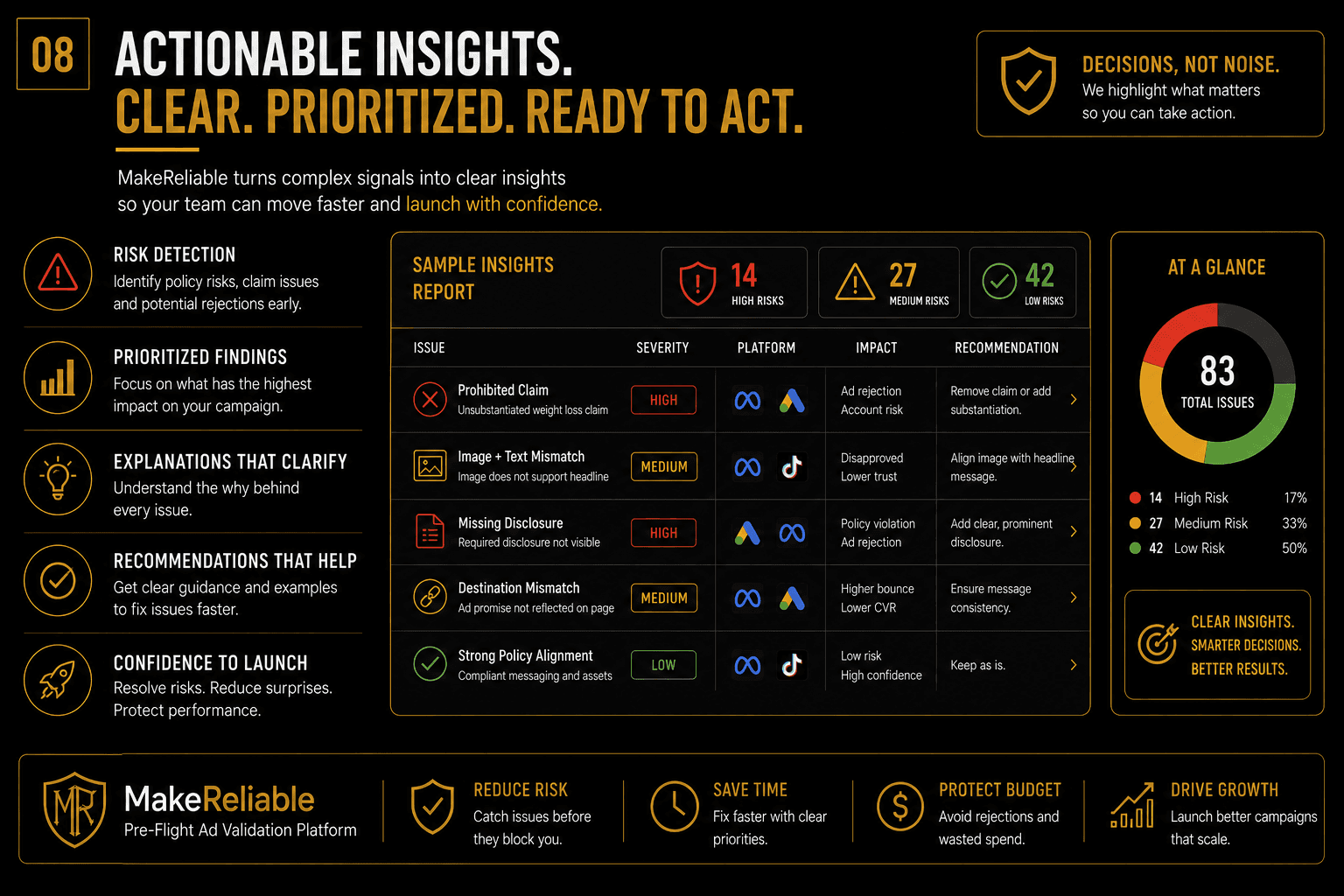
Agencies operate under compressed timelines, multiple stakeholders, and fast-moving landing pages.
That combination makes rejection risk harder to control unless review becomes operationally consistent.
The agency problem
Agency teams rarely work on one account, one offer, or one platform at a time.
That means small quality gaps multiply quickly:
- one weak claim becomes many ad variations
- one landing-page mismatch affects multiple campaigns
- one missing disclosure spreads across a full creative batch
Without prioritization, teams spend time everywhere and clarity nowhere.
What reduces rejection risk in practice
Agencies need a workflow that highlights what matters first.
That means:
- visible issue severity
- clear evidence behind each finding
- guidance that helps reviewers act quickly
- repeatable pre-flight review before submission
Actionable insights are more useful than generic alerts. They help teams decide what to fix, what to escalate, and what can move forward.
Why this matters commercially
Rejection risk is not only a compliance concern.
It affects:
- launch timing
- client trust
- internal workload
- media efficiency
- long-term account health
When agencies reduce preventable rejections, they protect both campaign momentum and operating margin.
The stronger model
The strongest agency model is not reactive firefighting. It is a visible pre-flight process that creates evidence, prioritization, and cleaner launch decisions before money is committed.