The Future of Accountable Advertising
Advertising is becoming harder to scale without accountability. Teams need to move fast, protect spend, reduce preventable risk, and prove that campaign decisions were based on evidence. Manual review alone is not enough. Accountable advertising needs infrastructure.
1. Accountable advertising starts before launch
Accountability should not begin after an ad is rejected or a campaign fails. It should begin before spend is committed, when claims, landing pages, visuals, targeting, disclosures, and approval workflows can still be checked.
That is when teams can still make lower-cost decisions. Before launch, the workflow can still be corrected without turning every issue into recovery work.
2. Reactive review cannot support modern campaign velocity
Agencies and growth teams are expected to launch more campaigns, more variants, and more landing pages across more platforms. If every issue is found manually after launch, the operating model becomes slow, expensive, and fragile.
Reactive review does not just slow one campaign. It compounds across launches, teams, and approval cycles.
3. Evidence matters more than opinions
Campaign review should not depend only on scattered opinions, screenshots, or last-minute comments. Teams need findings tied to evidence: the claim, page section, policy context, visual asset, offer mismatch, or operational reason the issue matters.
Evidence-first review makes accountability more practical because decisions are easier to explain internally and easier to revisit later.
4. The MakeReliable advantage
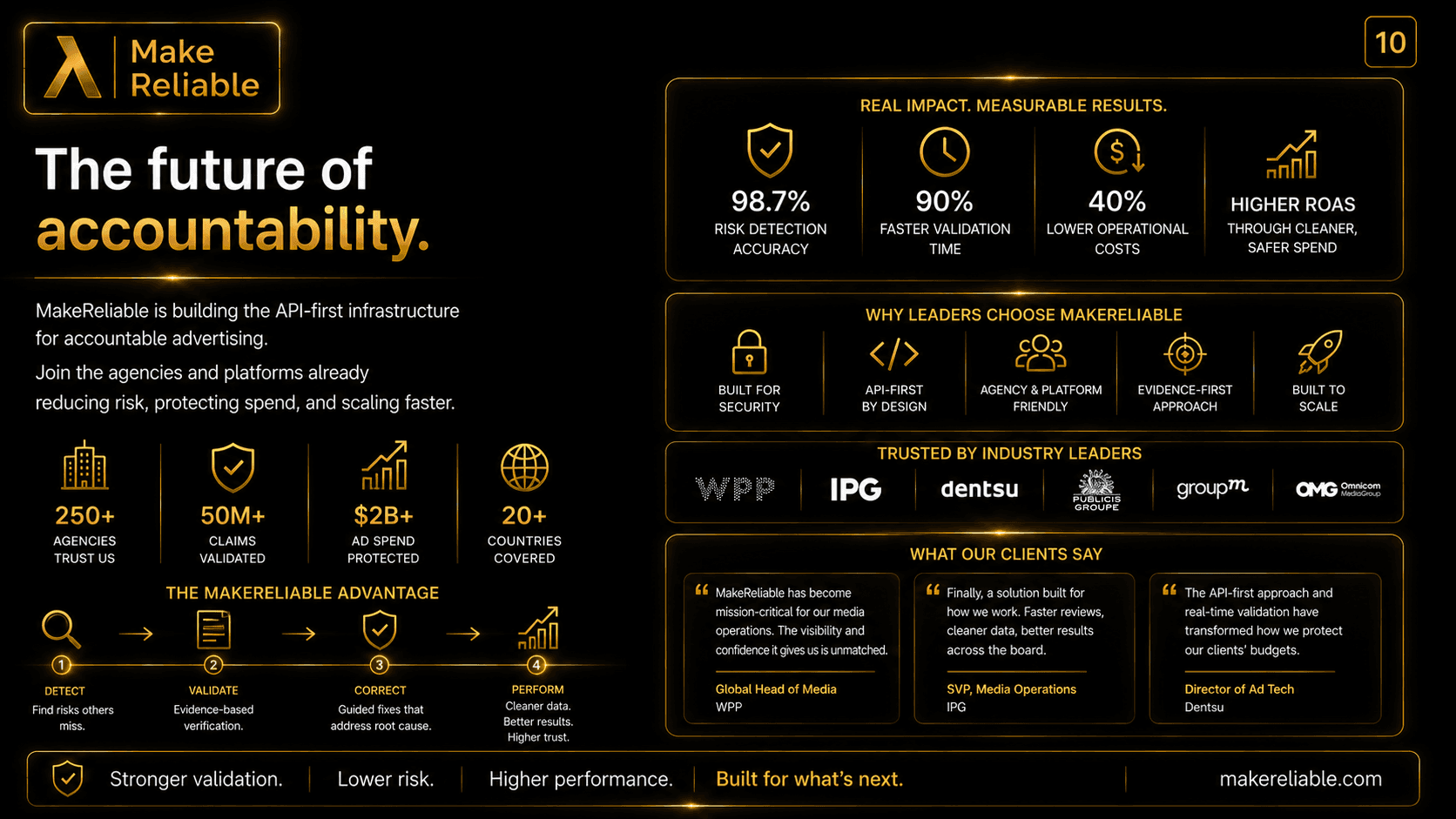
The MakeReliable flow can be framed as:
- Detect
- Validate
- Correct
- Perform
The goal is to help teams find risks earlier, validate findings with evidence, correct fixable issues, and improve operational confidence before campaigns scale.
This should not be read as a guarantee of complete detection, compliance, approval, or performance. It is a structured operating model for better pre-launch decisions.
5. API-first infrastructure makes accountability scalable
Accountability cannot depend only on manual review when campaign volume grows. API-first infrastructure allows validation to sit closer to the workflow: inside pipelines, browser checks, internal review, and reporting systems.
That makes accountability scalable because review is no longer limited to disconnected manual steps alone.
6. Accountable advertising needs an audit trail
Teams should be able to understand what was scanned, what was found, what evidence supported the finding, what was corrected, and what was approved. This creates better internal accountability and stronger launch decisions.
An accountability trail matters because it turns campaign review into an operational system instead of a collection of unstructured comments.
7. Better operations support better performance
Cleaner validation, fewer preventable issues, faster review, and better alignment can support stronger campaign operations. The point is not to promise guaranteed ROAS or performance. The point is that operational improvements can create better launch conditions.
That distinction matters. Better process is a strategic advantage even when outcomes still depend on execution, market conditions, and platform behavior.
8. Built for agencies and platforms
Agencies need visibility and collaboration. Platforms need consistency and scalable workflows. Media teams need speed and control. MakeReliable is designed as infrastructure for teams that want campaign accountability before spend is exposed.
This is why workflow integration matters. Accountability should be built into the operating model, not treated as an afterthought.
9. Avoid fake proof and focus on real accountability
Accountability is not about claiming unrealistic numbers or fake customer proof. It is about building a system where risks are detected earlier, findings are explained clearly, corrections are guided, and teams stay in control.
That is more credible than invented proof and more useful than vague promises.
10. The future is proactive, evidence-first, and API-driven
The future of advertising accountability is proactive validation, evidence-based review, guided resolution, workflow integration, and measurable operational improvement before launch.
That future depends on infrastructure that helps teams act earlier and more consistently, not just review harder after the fact.
Conclusion
The next generation of advertising operations will not rely only on reactive review. It will rely on infrastructure that helps teams detect risk, validate evidence, correct issues, and make better decisions before spend scales.
Stronger validation. Lower risk. Higher performance. Built for what's next.