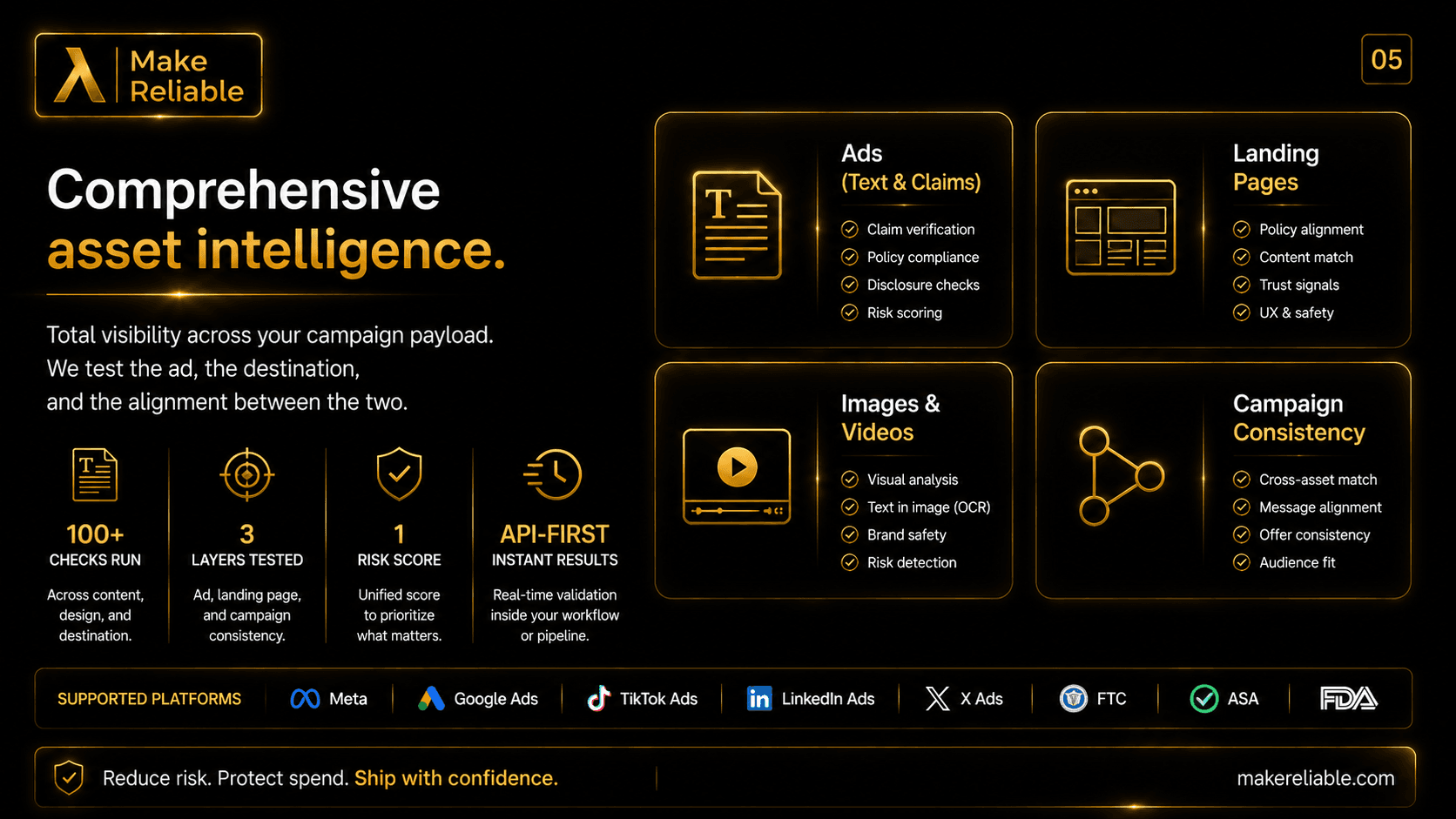
Campaign risk does not live in one place. It can appear in the ad copy, the landing page, the image, the video, the offer, the CTA, the disclosure, the audience, or the gap between them. That is why paid media teams need more than asset-by-asset review. They need comprehensive asset intelligence across the full campaign payload.
Campaign assets are usually reviewed in fragments
Creative, copy, landing pages, and strategy are often reviewed by different people, in different tools, at different moments. Each asset can look acceptable on its own while the full campaign still contains risk.
This fragmentation is common in real campaign operations. Designers review visuals. Copywriters review messaging. Media buyers review structure. Landing page owners review destination experience. But the campaign reaches the platform as one payload, not as separate approvals.
The real risk often hides in the alignment
A campaign can become fragile when the ad promise does not match the landing page, the visual implies a stronger claim than the copy, the CTA changes the offer, or the destination page lacks the trust signals needed for the message.
That is why alignment matters as much as individual asset quality. Risk often appears in the relationship between assets, not in the asset alone.
Ads need claim and policy intelligence
Ad text and claims should be checked for risky wording, unsupported promises, missing disclosures, policy sensitivity, and consistency with the destination page. The goal is not to guarantee approval, but to reduce avoidable rejection and review risk.
When teams validate claims early, they can catch issues while copy is still easy to change and before the ad enters the expensive zone of live review and budget exposure.
Landing pages are part of the campaign payload
The landing page is not separate from the ad. It carries the promise, proof, CTA, form flow, trust signals, UX, and safety signals that affect both approval risk and conversion quality.
If the destination page weakens the message, changes the offer, or removes the trust context needed by the ad, the campaign becomes less reliable before traffic even starts.
Images and videos create risk too
Visual assets can contain text, implied claims, sensitive imagery, before/after-style promises, brand safety issues, or audience expectations that do not appear in the written copy. Image and video review should be part of campaign validation.
This is especially important because visual interpretation often changes how the full campaign is perceived. The copy may be moderate while the image makes a stronger promise, creating a mismatch that raises risk.
Campaign consistency determines launch reliability
Teams need to compare the ad, the destination, the offer, the audience, the creative, and the follow-up path. Cross-asset mismatch can create policy risk, trust issues, wasted spend, and slower campaign decisions.
Consistency is what turns a set of separate assets into a reliable launch system. Without it, the team is reviewing fragments while the real operational risk remains hidden.
One risk score helps teams prioritize what matters
A unified risk score helps teams move from scattered comments to prioritized action. It gives campaign operators a clearer way to decide what needs review before launch.
Used carefully, this kind of scoring does not replace judgment. It helps teams focus attention where the campaign payload appears most fragile.
API-first asset intelligence makes validation scalable
Campaign teams cannot manually compare every asset, claim, landing page, visual, and variant forever. An API-first validation layer can help teams check campaign payloads more consistently inside their workflow or pipeline.
As campaign volume increases, consistency becomes harder to preserve with manual review alone. API-first validation helps bring the same launch-readiness discipline across more assets and more workflows.
What MakeReliable checks across the campaign payload
MakeReliable is designed to help review:
- ads - text and claims
- landing pages
- images and videos
- campaign consistency
- policy alignment
- content match
- trust signals
- UX and safety
- cross-asset match
- message alignment
- offer consistency
- audience fit
This is product-positioning language, not a promise of certification or guaranteed automation. The point is to surface risk signals across the campaign system before launch.
Comprehensive asset intelligence before launch
MakeReliable helps teams validate the ad, the destination, and the alignment between the two before paid media spend is exposed. It does not guarantee approval, legal compliance, or performance. It helps surface risk signals early so teams can launch with more confidence.
If you want to check the full campaign payload before launch, start here:
Related landing pages:
- Scaling paid media has a breaking point
- Reactive compliance destroys ROAS
- Validate before you commit spend
Conclusion
Paid media reliability depends on the full campaign system, not one isolated asset. Teams that validate campaign assets together can reduce avoidable risk, protect spend, and move faster with clearer launch decisions.
Reduce risk. Protect spend. Ship with confidence.