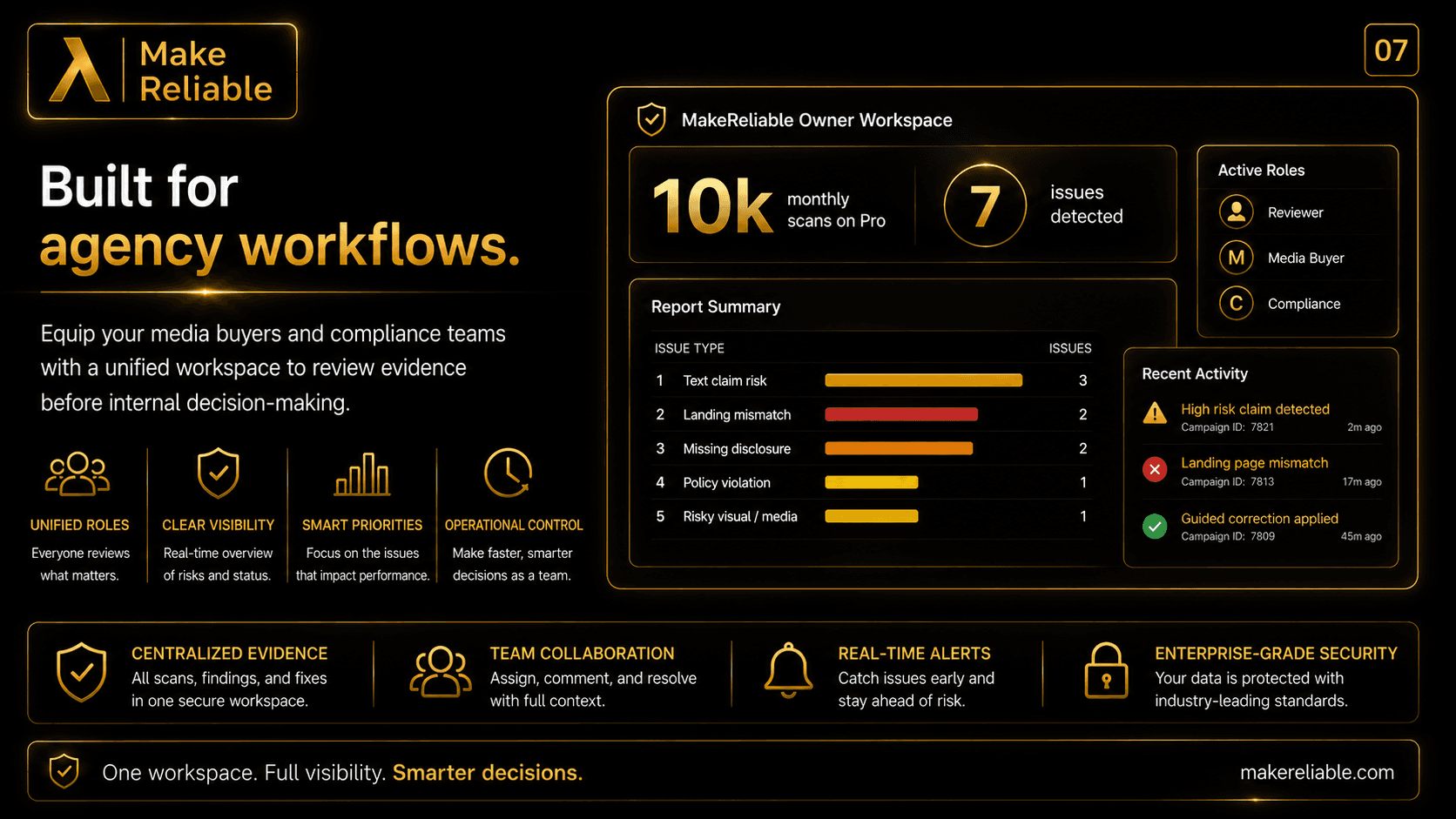
Built for Agency Workflows
Agency campaign review is rarely handled by one person. Media buyers, compliance reviewers, account managers, creative teams, and clients all touch the decision before launch. When evidence is spread across tools, teams move slower, miss risks, and waste time deciding what matters. Agencies need one workspace for campaign evidence, roles, priorities, and decisions.
1. Agency review breaks when evidence is scattered
Campaign findings, screenshots, landing page notes, policy concerns, creative comments, and client decisions often live in different places. This makes it harder to understand what was found, what needs attention, and what is ready to approve.
Scattered review creates slow handoffs. One team may see the landing page comment, another may see the claim warning, and a third may only see a partial summary in chat. When evidence is fragmented, the campaign review process becomes harder to trust.
2. Media buyers and compliance teams need the same context
Media buyers focus on launch velocity and performance. Compliance reviewers focus on risk, claims, disclosures, and platform safety. Both groups need the same evidence to make smart decisions.
If one team reviews performance risk while another reviews policy risk in isolation, the campaign can still move forward with missing context. Shared evidence makes tradeoffs easier to understand before launch.
3. Clear roles reduce review friction
A campaign workspace should make it clear who is reviewing, who owns the next decision, who needs to approve, and what has already been resolved. Role clarity helps agencies avoid repeated questions and last-minute confusion.
This matters most when many campaigns are moving at once. Agencies do not need more ambiguity around responsibility. They need a workflow where reviewer roles and next actions are visible.
4. Report summaries help teams prioritize
Agencies do not need every issue treated equally. They need report summaries that show issue type, severity, campaign impact, and which risks deserve attention first.
Instead of passing around a flat list of warnings, teams can make better decisions when findings are grouped by operational priority. That helps them focus first on the issues that are most likely to slow launch or create avoidable risk.
5. Recent activity keeps teams aligned
Recent activity helps teams see what changed: high risk claim detected, landing page mismatch, guided correction applied, finding resolved, or review completed. This makes campaign decisions easier to audit internally.
When activity is visible, launch teams spend less time reconstructing what happened and more time deciding what to do next.
6. Collaboration should happen around evidence
Comments and approvals should be attached to the finding, asset, landing page, or correction being reviewed. That keeps the decision connected to the evidence instead of buried in chat threads.
This is one of the biggest differences between a generic operations dashboard and a true campaign review workspace. Collaboration works better when the evidence is the center of the workflow.
7. Security and client trust matter
Agencies handle sensitive campaign data, client offers, landing pages, budgets, and strategic assets. A campaign validation workspace should be designed with serious operational controls and careful handling of sensitive data.
The goal is not to make unsupported certification claims. The goal is to give agencies a security-conscious workspace that treats campaign review as a serious operational function.
8. Unified workflows create smarter decisions
When all scans, findings, fixes, roles, and activity are centralized, teams can focus on what matters. They can reduce review friction, prioritize risks, and make faster internal decisions.
That makes launch workflows more structured without removing human judgment. Teams still decide. They just do it with better evidence and clearer visibility.
9. MakeReliable for agency workflows
MakeReliable equips agencies with a unified workspace to review evidence before internal decision-making. Media buyers, reviewers, and compliance teams can work from the same findings, prioritize performance-impacting issues, and launch with more confidence.
This is about structured internal review, not automatic publishing. MakeReliable does not guarantee approval, legal compliance, or campaign performance. It helps teams make smarter launch decisions with shared context and evidence-backed findings.
Conclusion
Agencies do not need more scattered review. They need one workspace where evidence, roles, priorities, corrections, and decisions come together before launch.
One workspace. Full visibility. Smarter decisions.