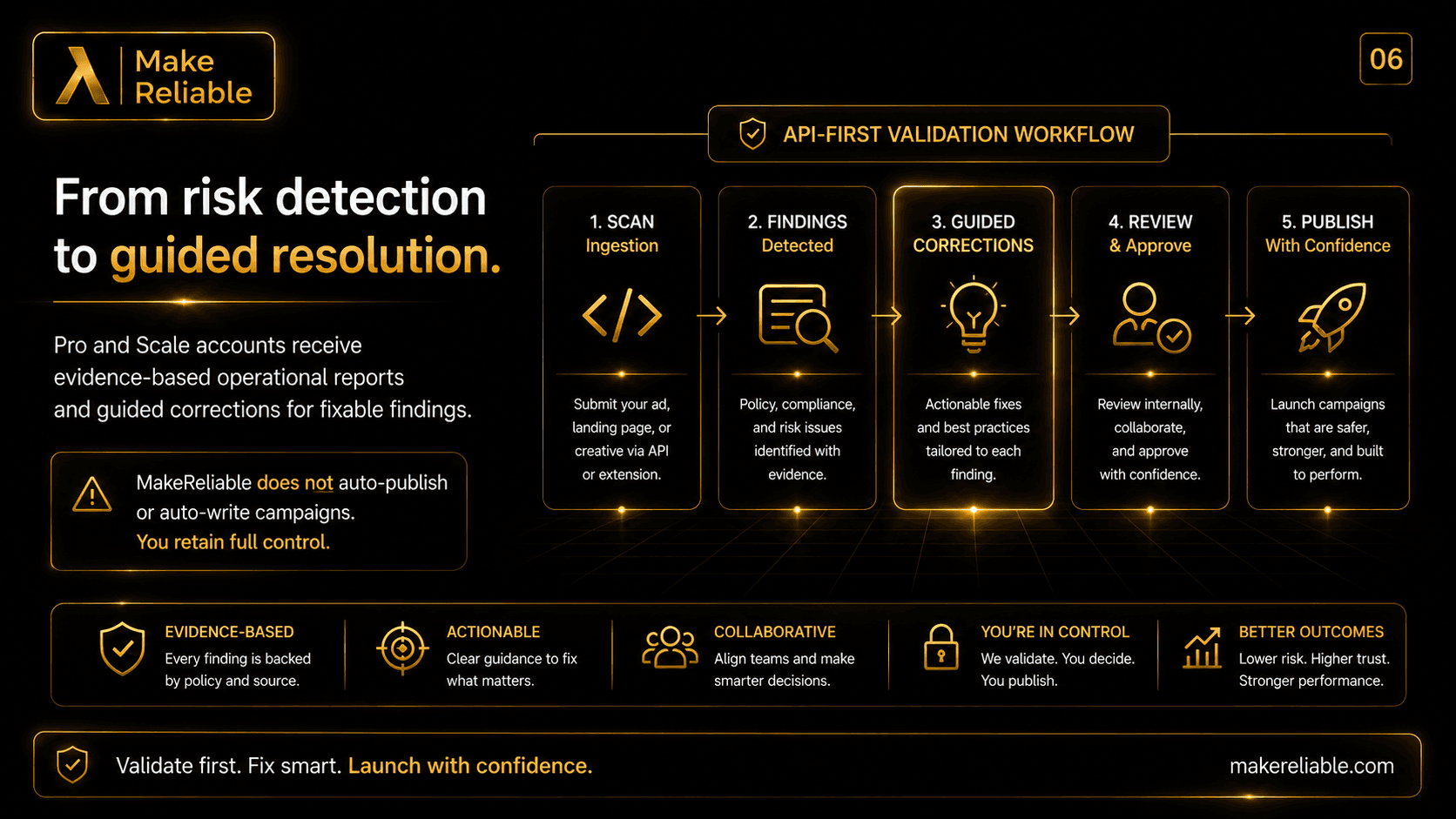
From Risk Detection to Guided Resolution
Risk detection is only useful if teams receive evidence-based findings and guided corrections they can review and approve before publishing. Detection alone leaves operators translating warnings into action under pressure. Guided resolution gives teams a clearer path from issue discovery to safer launch decisions.
1. Risk detection is only the first step
Many validation systems stop after surfacing a warning or flag. That is helpful, but it is not enough for real campaign operations. Launch teams still need to understand what the issue means, whether it matters, and what should happen next before the campaign goes live.
If the workflow ends at detection, teams are left doing manual interpretation during review windows that are already tight. That slows launches and creates inconsistent decisions.
2. Findings need evidence
Useful findings should be backed by policy references, source context, or clear explanation. Without evidence, teams have to debate whether the issue is real, how severe it is, and whether it deserves action.
Evidence-based findings make review faster because the team can see why the issue was surfaced. That improves trust in the validation process and makes internal review more operational.
3. Guided corrections reduce wasted review time
Detection becomes more valuable when it is paired with guided corrections. Teams should not have to guess how to respond to every finding or re-explain the same issues across marketing, compliance, and leadership stakeholders.
Guided corrections turn findings into clearer next steps:
- what is wrong
- why it matters
- what should be reviewed
- what can be corrected before launch
That reduces wasted review time and helps teams prioritize the fixes that matter most.
4. Campaign review should remain collaborative
Campaign launches often involve multiple roles: media buyers, copywriters, landing page owners, reviewers, and decision-makers. A useful resolution workflow should support collaboration rather than bypass it.
Findings and corrections should be shareable, discussable, and reviewable before publishing. This helps teams align around the same operational report instead of chasing fragmented comments in different tools.
5. The customer must stay in control
Control should remain with the customer team at every step. MakeReliable does not auto-publish or auto-write campaigns. You retain full control.
That distinction matters. The purpose of guided resolution is to support better decisions, not to remove human approval or imply guaranteed platform outcomes.
6. The API-first validation workflow
An API-first workflow makes guided resolution easier to operationalize across teams and campaign volume. The workflow can be understood in five stages:
- Scan ingestion
- Findings detected
- Guided corrections
- Review & approve
- Publish with confidence
This sequence helps teams move from signal to action while keeping review and publishing decisions inside their own control structure.
7. Guided resolution is different from generic advice
Generic advice is broad and easy to ignore. Guided resolution should be specific to the campaign, linked to real findings, and framed so the team can act on it.
That means the output should feel operational, not theoretical. Instead of a vague warning, the team needs evidence-based findings and guided corrections that fit the actual launch workflow.
8. Why Pro and Scale teams need operational reports
As campaign volume increases, review consistency becomes harder to maintain. Pro and Scale teams need operational reports that help them compare findings, align reviewers, and decide what must be addressed before launch.
Evidence-based operational reports also make it easier to explain decisions internally. Teams can review the same findings, understand the same sources, and move faster without giving up control.
9. Better outcomes come from controlled resolution
Better outcomes do not come from automation alone. They come from controlled resolution: lower risk, higher trust, and stronger performance because teams are acting on clearer findings before publishing.
This is especially important when campaigns affect budget exposure, internal approvals, and launch timing. Controlled resolution supports safer launch decisions without promising guaranteed approval or legal certainty.
10. From detection to resolution
MakeReliable helps Pro and Scale accounts move from campaign risk detection to evidence-based operational reports, guided corrections, internal review, and safer launch decisions.
Validate first. Fix smart. Launch with confidence.