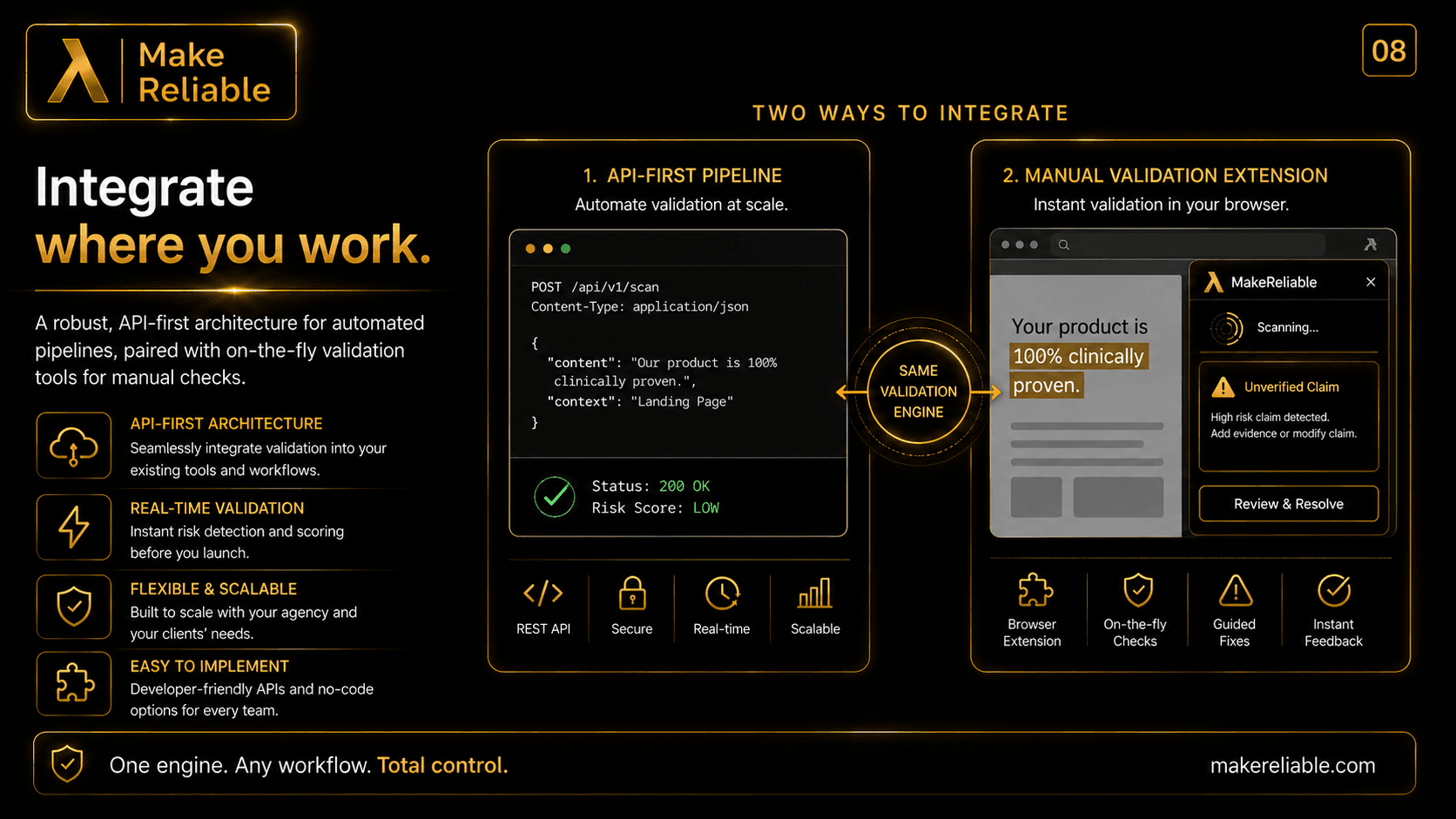
Integrate Where You Work
Campaign validation is most useful when it fits the workflow teams already use. Some teams need automated checks inside their pipeline. Others need fast manual validation inside the browser before approval. Many agencies and growth teams need both. The challenge is keeping those workflows connected to the same validation logic.
1. Campaign validation should not live in a separate silo
If validation happens in a disconnected tool, teams have to copy assets, repeat checks, and reconcile results manually. That creates friction and increases the chance that campaign risk is missed before launch.
Validation should move closer to the places where teams already review campaigns, not farther away. Otherwise, the process becomes slower precisely when launch teams need faster decisions.
2. API-first pipelines help teams validate at scale
Technical teams and high-volume agencies need validation that can run inside existing systems. API-first validation can support automated checks for ads, claims, landing pages, and campaign assets before they are pushed into launch workflows.
This matters when teams need repeatable review across large campaign volume. A pipeline-friendly approach helps validation happen before launch decisions are locked.
3. Manual browser checks are still essential
Not every review starts in a pipeline. Media buyers, reviewers, and account teams often need to check a claim, landing page, or creative while browsing. A manual validation extension can help teams detect risk in context without leaving the workflow.
That makes browser-based review useful for the moments when judgment, speed, and visual context matter most.
4. The key is using the same validation engine
API checks and manual browser checks should not produce disconnected logic. When both workflows rely on the same validation engine, teams can keep scoring, findings, and guidance consistent across technical and manual review paths.
Consistency matters because it reduces review confusion. Different interfaces can still produce one shared structure for findings and resolution.
5. API-first pipeline workflow
An API-first workflow can be understood as a simple operational sequence:
- Submit content or campaign assets
- Include context such as ad, landing page, or creative
- Receive findings and risk scores
- Route findings into internal review
- Use results before launch decisions
Any sample endpoint or request structure should be treated as illustrative unless the exact production interface is already confirmed by product documentation. The important point is the workflow shape, not a claim about a public endpoint.
6. Manual validation extension workflow
The browser-based path is different but complementary:
- Open page or asset in browser
- Run on-the-fly validation
- Detect risky claims or mismatch
- Review guided fixes
- Keep the human reviewer in control
This positions the extension as manual validation and review support, not auto-publishing or uncontrolled automation.
7. One engine helps teams maintain control
MakeReliable should not be positioned as an uncontrolled automation layer. The right model is validation, evidence, guidance, review, and approval. Teams can use automation where it helps and manual review where judgment is required.
That keeps customer control explicit. The system helps surface risk and structure review, but the team still decides what should happen before launch.
8. Flexible integration supports different teams
Developers may need API access. Media buyers may need browser checks. Compliance reviewers may need reports. Agency owners may need workspace visibility. A flexible validation engine supports these roles without fragmenting the risk model.
That is what good workflow integration means in practice: different entry points, one shared review standard.
9. What "integrate where you work" means
It means campaign validation can be embedded in existing tools, pipelines, browser sessions, and review workflows. The goal is not to force teams into a new process, but to bring risk detection and guided resolution closer to the decisions that happen before launch.
When validation fits the workflow, it becomes more likely to be used consistently and earlier in the launch process.
10. MakeReliable for API and browser workflows
MakeReliable provides an API-first validation architecture paired with on-the-fly browser validation tools. Both paths are designed to help teams catch risk earlier, review findings faster, and launch with more control.
The shared value is not just access through multiple surfaces. It is the consistency of using one validation engine across automated and manual workflows.
Conclusion
Campaign validation should be available where the campaign work happens. With one engine across API-first pipelines and browser-based checks, teams can reduce fragmented review, improve consistency, and stay in control before launch.
One engine. Any workflow. Total control.